

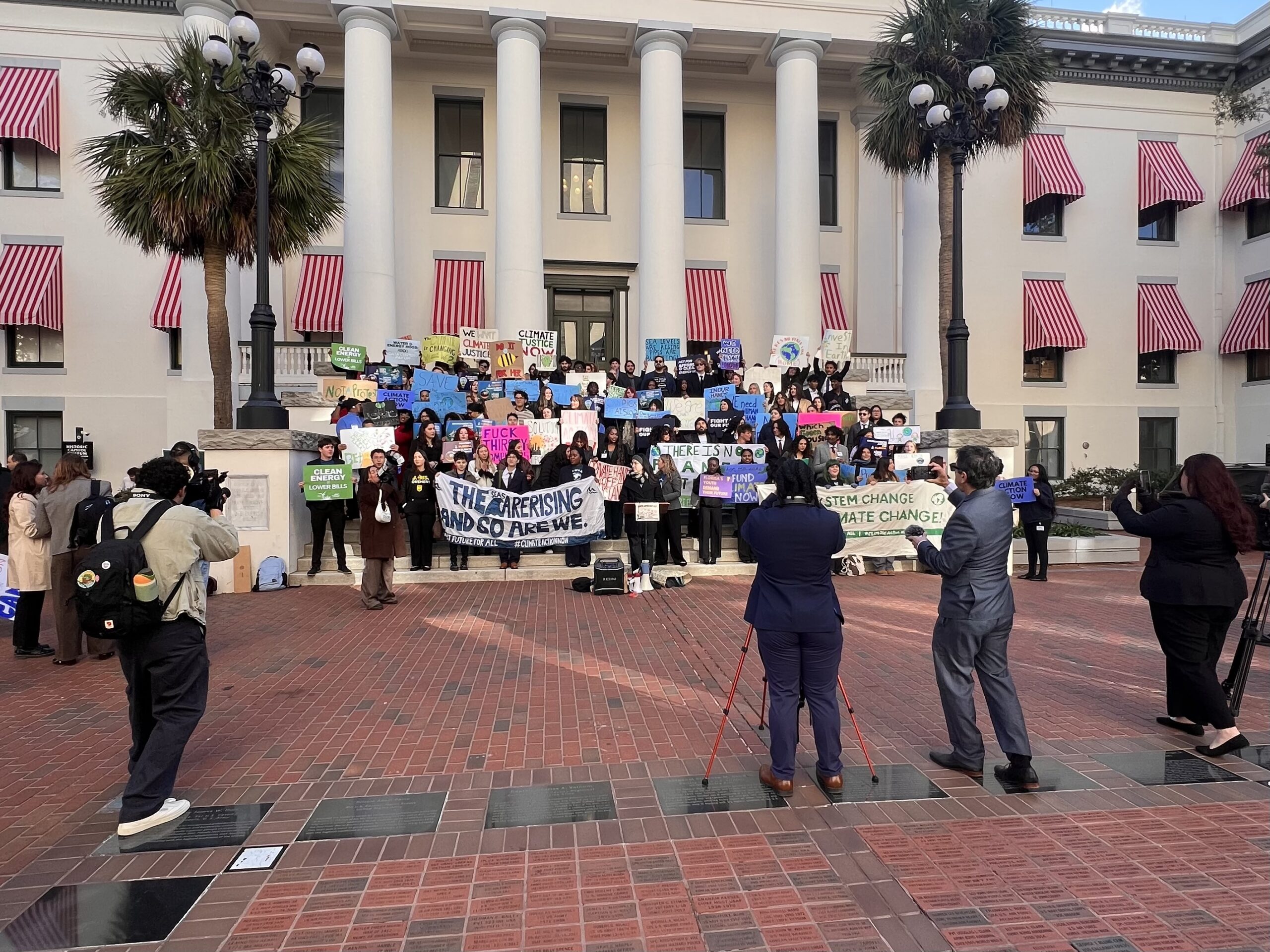
Protestors rally against climate change at the Florida Capitol. (Sha’niyah Ellies/WANM)
The Florida Capitol is increasingly serving as a shared platform for overlapping protest movements, as activists unite across environmental, political and international issues to demand policy change and accountability.
In late January, environmental activists, human rights advocates and participants in the “No Kings” movement converged at the Capitol Complex, showing how urgent concerns increasingly complement each other across causes.
The intersection of these movements suggests that, for many protesters, local policy debates are increasingly linked to national power and global human rights struggles.
Florida A&M University student Camron Curry, who joined climate activists on Jan. 29, said environmental justice is inseparable from politics.
“Everything starts with policy,” Curry said. “We can’t address pollution in our water or air without policy.”
Days earlier, the Jan. 24 “No Kings” protest drew both domestic and international voices. While demonstrators criticized policies of President Donald Trump’s administration, Iranian human rights advocates joined the gathering to highlight political repression in Iran and demand an end to the regime.
The Iranian group was not formally affiliated with No Kings but joined the protest to raise awareness during Florida’s legislative session, using the visibility of the Capitol to amplify their message.
Curry said the overlap between movements reflects a shared concern over silenced voices. “You don’t want to silence citizens when it’s time to speak,” he said.
The No Kings movement has repeatedly returned to the Capitol, holding demonstrations there in June and October 2025. Organizers say the Capitol’s symbolic power makes it a natural gathering place for protest.
Curry said the overlap between movements reflects a shared concern over silenced voices. “You don’t want to silence citizens when it’s time to speak,” he said.